Dance is a Beautiful Art form. It is a performing art which consists of sequence of steps or a movement of person rhythmically to the music. The Art of Dance being based on some scientific principles which gives you immense benefits and advantages.
Presiding deity of dance
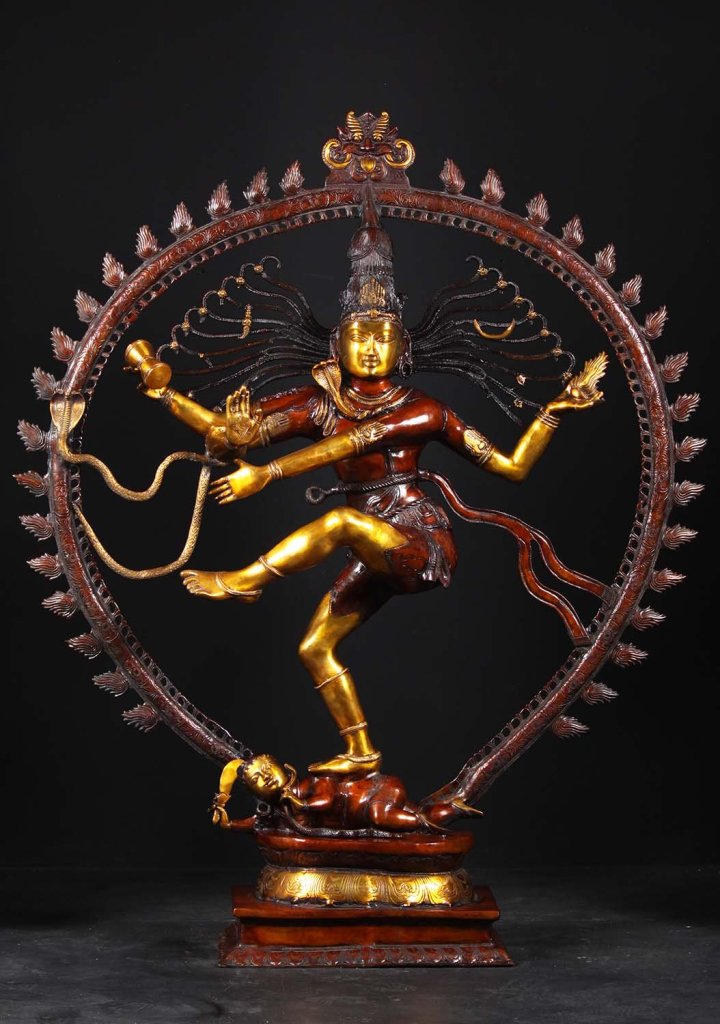
Once, there was a discussion between Lord Shiva and Goddess Parvathi to know who would perform gracefully and the competition was held between them.
Both of them agreed to perform in front of the goddess and angels, while they were dancing, Lord Shiva lifted his one leg up and performed the Urdhwa Tandava, looking at Shiva’s Tandava, Parvathi stood silent without dancing. So, it was Shiva’s victory.
Because of this reason, Lord Shiva was addressed as Nataraja.
So, we consider that Nataraja is a replica of Lord Shiva, who is the presiding deity of Dance.
“Angikam bhuvanam yasya
Vachikam sarva vangmayam
Aharyam chandra taradi
Tam numah satwikam sivam.”
Origin of dance
In this world, there are many aesthetic creations and which Dance is one among them. Since, ancient times dance has a very prominent place.
Once Devendra approached Lord Brahma and asked him to create a new Veda. So, Brahma meditated for a long time and created a new veda. The new veda got inherited by other four Veda like:
– Literature was taken from Rig Veda
– Abhinaya ( Expressive Techniques ) was taken from Yajur Veda
– Musical aspects was inspired from Sama Veda and
– Rasa (what the mind feels and the expression of the feeling thereafter) from Atharvana Veda.
By the references of all these Veda Lord Brahma created a new Veda called Natya Veda .
Later, Brahma taught this veda to Bharatha and told him to practice this veda along with his children. Accordingly, Bharatha started his teaching with 3 Vruthis(styles) to his 100 children and the Vruthis are like this
- Bharathi means Vachika ( Speech )
- Sathwati means Satva ( Pure soul )
- Arbhati means Arbata ( Strong )
Later, they performed it in front of Shiva, After watching this performance, In additional to these vruthis Shiva added Kaishiki Vruthi(Graceful Style).
To perform this Kaishiki Vruthi, again Brahma created 24 Nymphs(Apsaras) and Kaishiki Vruthi was added to Natya Veda. There after, Bharatha learnt Tandava from Thandu who was a disciple of Shiva and Lasya from Usha who was a devotee of Goddess Parvathi. Thus, giving birth to the miraculous and powerful art, Natya.
Existence of dance
The author of Natyashastra is Bharatamuni, which was based on his creation, ideologies, choreography and teaching, which was written in the 2nd century, thereafter many dance forms got originated in India.
Based on this, various dance forms influenced by their provincial life, culture and region, gradually evolved into a traditional and elegant form of dance that was later known as classical.
Major forms of dance among them are Bharathnatyam from Karnataka and Tamil Nadu, Kuchupudi from Andhra Pradesh, Kathakali from Kerala, Mohiniattam from Kerala, Kathak from Uttar Pradesh, Odissi from Orissa, Yakshagana from Karnataka, Chow from Bihar and Sathriya from Assam.
After Independence all these art forms were included in the Gazetteer of India. Hence, These are called as National Classical Dances of India .
In early times, this classical dance was performed by Devadasis which was predominant in Temples.
All forms of dance was simply a beautiful art embodying the spiritual sentiments of humanity towards divinity. This is why the classical dance forms are the epitome of Indian Culture.
During the 20th century, the status of these clans has deteriorated and their practices of dance went into decline. It regained its former glory due to the efforts of Great poet Rabindranath Tagore, Smt. Rukmini Devi Arundale, Sri Ramgopal, Krishna Iyer, and Sadashivaiah.
After Independence, many artists have dedicated their lives to this and now these dance forms which were confined within India, are now popular all around the Globe.
This was how Natya came into existence, and the story of Nataraja, considered a pious deity of Natya. The main moral I learnt from Lord Nataraja to be the artist I am today, is Devotion, Diligence and Dedication.
I call them as my D3 factor.
Devotion, Diligence and Dedication are very much necessary for learning and practicing Dance. Thus, it is my strong belief that,
“Artists comes from Everywhere but, Art comes from HEART”

 Sathwika Abhinaya
Awesome 👏 keep up the good work
LikeLiked by 1 person
Thank you ☺
LikeLiked by 1 person
Excellent!! Very well written, Informative.
Keep going 👍🏻
LikeLiked by 1 person
Thank you, means a lot☺
LikeLiked by 1 person
Neat sathwika
LikeLiked by 1 person
Thank you
LikeLike
With all love and respect to dance you’re doing a great job… Keep it going girl
LikeLike
Sure 😍, Thank you so much
LikeLike
Awesome and excellent. Very informative blog. I wish u all the best for ur future.
LikeLiked by 1 person
Thank you so much mam ☺
LikeLike
Super 👏🏻👏🏻👏🏻
LikeLiked by 1 person
Thank you 😊
LikeLike
Super akka♥️👏
LikeLiked by 1 person
Tqu dr
LikeLiked by 1 person
Great work👏👏 and very useful information for the people who would like to know about Dance.
Expecting more such information from your end.
LikeLiked by 1 person
Sure, Thank you so much😊
LikeLiked by 1 person
Very good…continue the same spirit
LikeLiked by 1 person
Thank you mam.
LikeLike
Wah!! You are Awesome!! Yashu, and very informative blog about classical dance.. all the best…🤗🙌 Keep rocking
LikeLike
Thank you so much, Means a lot.
LikeLike
Good one! Waiting for the next post eagerly! 🙂
LikeLike
Sure, Thank you
LikeLiked by 1 person
Natyashastra by Bharata muni is the most detail and elaborate of all treatises on dramatic criticism and acting ever written in any language and is regarded as the oldest surviving text on stagecraft in the world.
https://www.indianetzone.com/35/natyashastra_treatise_on_indian_dramaturgy.htm
LikeLike